Chemotype: Why the Same Plant Can Produce Different Oils
Botanical identity tells us what the plant is. Chemotype can tell us more about the chemistry it expresses.
Two essential oils can come from the same botanical species and still present noticeably different chemical profiles. That is where chemotype becomes useful.
A chemotype describes a chemically distinct expression found within the same plant species. The plants may appear very similar, yet the essential oils they produce can contain certain compounds in quite different proportions.
It is an important reminder that identifying the plant is only the beginning.
Botanical Name and Chemical Expression Are Not the Same Thing
A botanical name tells us which plant we are looking at.
But an essential oil is not a single substance. It is a complex mixture of volatile compounds, often containing many individual constituents in different proportions.
Within the same botanical species, those proportions can vary enough to create recognisable chemical patterns.
That is the idea behind chemotype.
Chemotypes are often written using “ct.” followed by the compound that helps define that particular chemical expression.
For example:
Thymus vulgaris ct. linaloolThymus vulgaris ct. thymol
Both belong to the same botanical species.
Chemically, however, they may represent substantially different expressions of that plant.
The botanical identity remains constant while the internal balance of aromatic compounds changes.
Why Can the Same Species Produce Different Chemistry?
There is rarely one simple explanation.
Genetics can influence which aromatic compounds a plant is capable of producing. Different populations within the same species may inherit differences in the biochemical pathways responsible for volatile compounds.
Environment also plays a role.
Temperature, rainfall, altitude, soil, sunlight, stage of growth and harvest timing can all influence the composition of an essential oil.
This does not mean every difference between two harvests should automatically be described as a different chemotype.
Botanical materials naturally vary.
Chemotype becomes most useful when the differences form a recognisable and meaningful chemical pattern, rather than simply representing ordinary batch-to-batch fluctuation.
In many cases, genetics and environment work together.
The plant provides the potential.
Place and growing conditions influence how that potential is expressed.
Rosemary Makes the Idea Easier to See
Rosemary is one of the most useful examples for understanding chemotype.
Rosemary essential oils can contain different proportions of compounds including 1,8-cineole, camphor, α-pinene and verbenone.
Depending on the chemical profile, rosemary oils may therefore be described using expressions such as:
Rosemary ct. cineoleRosemary ct. camphorRosemary ct. verbenone
The plant is still rosemary.
What changes is the relative chemical balance of its essential oil.
Those chemical differences can also influence sensory character. One rosemary may feel fresher and more expansive, while another can appear sharper, more penetrating or more camphoraceous.
This is why the words “rosemary essential oil” tell us something important, but not necessarily everything.
One Botanical, Two ARAU Expressions
This idea is also reflected directly within the ARAU collection.
ARAU currently curates two rosemary essential oils:
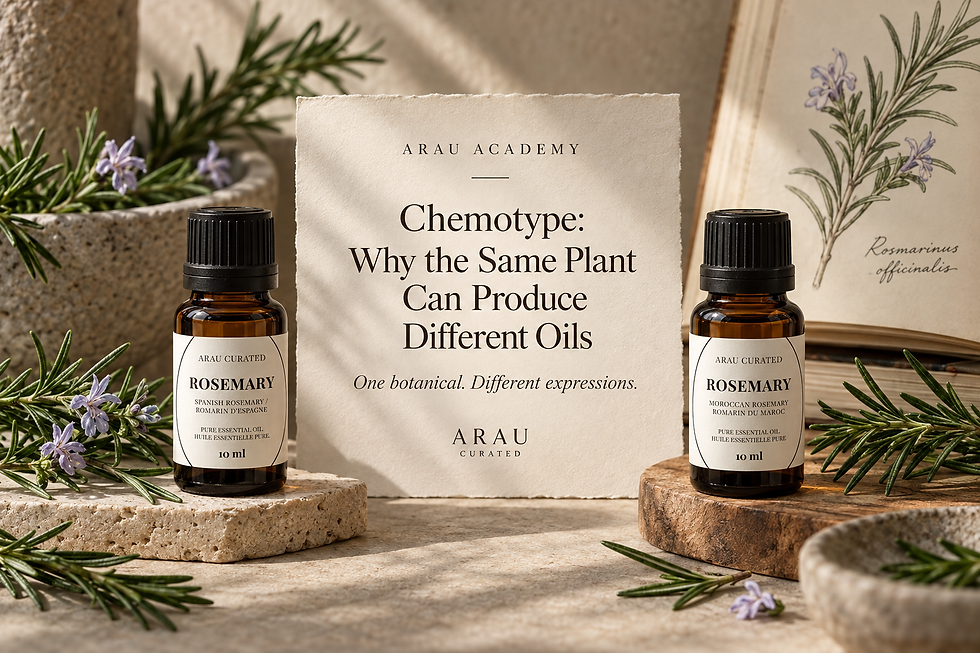
Spanish Rosemary — ct. CamphorMoroccan Rosemary — ct. Cineole
Both begin with the same familiar botanical identity: rosemary.
But ARAU does not treat them as interchangeable simply because the common plant name is the same.
The Spanish expression is selected around a camphor-led profile, while the Moroccan expression represents a cineole-led direction.
That difference is precisely why both can have a place within one collection.
They are not duplicate products.
They are two expressions of rosemary.
This is an important example of what curation means within ARAU.
We are not simply asking whether rosemary is already present in the collection.
We are asking whether a particular rosemary offers a distinct botanical, chemical and sensory expression that adds something meaningful.
In this case, the answer is yes.
Chemotype Is Not the Same as Origin
The ARAU rosemary example also illustrates another important distinction.
Chemotype and provenance are related, but they are not the same thing.
Our Spanish Rosemary and Moroccan Rosemary come from different origins, and they also represent different chemotypic expressions.
But we should not conclude that Spain automatically means camphor, or that Morocco automatically means cineole.
Geography may influence chemical expression, and some growing regions can become associated with particular profiles, but country of origin alone does not establish chemotype.
That requires supporting chemical information.
This distinction matters.
Origin should inform investigation, not replace analysis.
Knowing where a botanical was grown gives us one layer of understanding.
Knowing its chemistry gives us another.
ARAU considers both.
How Is Chemotype Identified?
This is where analytical testing becomes particularly useful.
Gas chromatography, often combined with mass spectrometry — GC/MS —, allows many of the volatile compounds within an essential oil to be separated and identified.
The resulting profile shows which constituents are present and their approximate relative proportions.
When a botanical is known to produce different chemotypes, this chemical information can help establish which expression a particular oil represents.
The distinction is useful:
Chemotype describes the chemical expression.
GC/MS is one of the principal tools used to examine that expression.
This is also why an essential oil cannot always be understood from one dominant number alone.
The relationship between several constituents can be just as informative as the presence of one major compound.
GC/MS deserves its own discussion, and we will explore it separately in ARAU Academy.
Can You Smell the Difference?
Sometimes, quite clearly.
Changes in chemical composition can influence aroma.
Different expressions may appear more herbal, fresh, camphoraceous, green, penetrating, floral or woody depending on their composition.
Our two rosemary selections provide an intuitive example of this.
A cineole-led rosemary and a camphor-led rosemary both remain recognisably rosemary, yet they need not present themselves in exactly the same way.
This is one of the most interesting aspects of essential oils.
Difference does not always begin with a different plant.
Sometimes it begins within the same one.
But sensory evaluation should not replace chemical identification.
Smell tells us how the material expresses itself to the senses.
Analysis helps us understand the composition behind that expression.
For ARAU, those two forms of evaluation are complementary rather than interchangeable.
Why Chemotype Matters in Curation
When ARAU evaluates an essential oil, botanical name is not treated as the final step.
We consider the species, plant part, provenance, extraction method, documentation, chemical profile and sensory character together.
For botanicals known to produce different chemotypes, that additional layer becomes especially valuable.
It helps explain why two oils that appear identical on a simple product list may actually represent quite different botanical expressions.
Our Spanish Rosemary ct. Camphor and Moroccan Rosemary ct. Cineole demonstrate this clearly.
If selection were based only on the word “rosemary,” carrying both could appear unnecessary.
Once chemotype, provenance and sensory character are considered, the reasoning becomes very different.
This is part of what curated means to ARAU.