Why Origin Matters in Essential Oils
Updated: 2 days ago
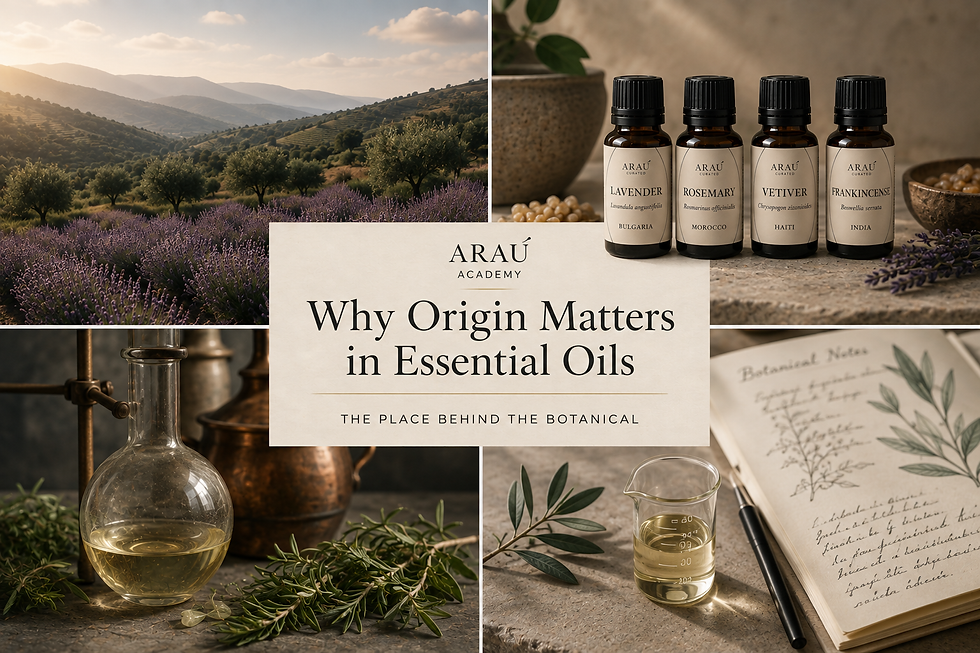
The Place Behind the Botanical
An essential oil may carry the same botanical name and still express itself differently depending on where and how the plant was grown.
Lavender from one region may not present exactly like Lavender from another.
Vetiver from Haiti can differ noticeably from Vetiver associated with Java. Rosemary can vary again depending on geography, chemotype, climate, harvest conditions, and production.
This is one of the reasons ARAU believes an essential oil should tell you more than simply what plant it came from.
We also want to know where it came from — and why that origin was selected.
A Botanical Is Shaped by Place
Plants respond continuously to their surroundings.
Temperature, rainfall, sunlight, altitude, soil, water availability, seasonal changes, and local growing conditions can all influence how an aromatic plant develops.
These environmental factors can affect the secondary metabolites produced within the plant and, in turn, the composition and aromatic character of the essential oil obtained from it.
That does not mean every oil from a particular country will smell exactly the same, nor does it mean one geography is automatically superior to another.
But origin provides context.
It tells us something about the environment in which that botanical developed before it ever reached the still.
Origin Is Important — But It Is Not the Whole Story
Geography is only one part of essential oil identity.
Botanical species matters.
Chemotype can matter.
The part of the plant used, maturity at harvest, season, cultivation, drying, handling, distillation conditions, storage, and age can all influence the final oil.
This is why ARAU does not approach sourcing with a simple rule such as:
“This country produces the best version.”
Instead, we ask:
What expression are we looking for from this botanical, and which origin helps us find it?
That distinction is important.
Origin should inform selection, not replace evaluation.
When Place Becomes Character
Some botanicals demonstrate the importance of provenance particularly clearly.
Vetiver is one example.
The botanical may be identified under the same species, yet Haitian Vetiver and Java Vetiver can present very different aromatic impressions. One may appear cleaner, smoother, or more refined; another may feel earthier, smokier, heavier, or more rugged.
Neither is automatically “better.”
They are simply different expressions of the same botanical.
Rosemary provides another example.
A bottle labelled simply “Rosemary Essential Oil” tells only part of the story. Depending on origin and chemotype, the aromatic profile can move from fresh and cineole-rich to sharper, more camphoraceous territory.
For ARAU, those differences are not inconveniences to be hidden.
They are part of what makes botanical sourcing interesting.
Why ARAU Shows Origin
Across the ARAU essential oil collection, we obtain origin information from our suppliers and present that declared provenance alongside the oil.
We do this because transparency matters.
When someone encounters an ARAU essential oil, we want its identity to extend beyond the common name printed on the front of the bottle.
We want the customer to be able to understand:
the botanical name,
the origin,
the plant material,
the extraction method where relevant,
and the chemotype when it meaningfully distinguishes the oil.
Origin alone does not guarantee quality.
But without origin, part of the botanical story is missing.
Why ARAU Works with Different Suppliers
ARAU is not built around a single supplier catalogue.
That is deliberate.
Different suppliers may have stronger relationships with particular growers, regions, farms, or distillers. One supplier may have access to an Australian native oil with exactly the character we are seeking. Another may offer a Moroccan Rosemary that better reflects the aromatic direction we want. Another may provide Vetiver from a provenance that deserves a different place within the ARAU classification.
So our process is not:
Choose one supplier → select oils from its catalogue.
Our process is closer to:
Consider the botanical → understand the expression → evaluate the origin → select the source.
That is an important difference.
It gives ARAU the freedom to build a collection around the character of the botanicals themselves rather than around the convenience of purchasing everything from one place.
The Curated Spirit of ARAU
The word curated is used frequently today, but for ARAU it has a very specific meaning.
To curate is not simply to collect.
It is to select with reason.
That reason may involve provenance.
It may involve aromatic character.
It may involve documentation, intended application, rarity, botanical significance, or how an oil contributes to the wider ARAU archive.
Sometimes a familiar origin is exactly what we want.
Sometimes a less obvious origin offers a more interesting expression.
And sometimes two origins of the same botanical deserve to exist side by side because each reveals a different part of its character.
This is why ARAU can source from different suppliers without seeing that diversity as inconsistency.
For us, it is part of the method.
From Origin to Bottle
A country of origin may appear as only one line on a label.
But behind that line is a much longer journey:
Plant → environment → harvest → distillation → documentation → evaluation → selection → bottle.
Understanding origin helps us see essential oils not as completely interchangeable commodities, but as botanical materials shaped by place, time, and production.
That does not mean origin should become mythology.
It should become information.
And when combined with botanical identity, documentation, and sensory evaluation, it becomes one more reasoned part of the selection process.
That is why ARAU records origin.
That is why we show it.
And that is why our collection is built across different suppliers and different regions.
We do not choose a supplier and then decide what to buy.We consider the botanical first, then seek the origin and expression that best fits the ARAU collection.
That is the curated spirit behind the archive.