What Is an Essential Oil?

More than fragrance: understanding the botanical material, volatile chemistry and process behind the bottle.
ARAU Academy
Open a bottle of lavender, cedarwood or bergamot and the first impression is immediate: aroma.
It is tempting, then, to think of an essential oil simply as the concentrated scent of a plant. That is a useful starting point, but it does not tell the whole story.
An essential oil is a complex mixture of volatile compounds obtained from botanical material, most commonly through distillation. In the case of many citrus oils, the aromatic material can instead be obtained mechanically from the peel.
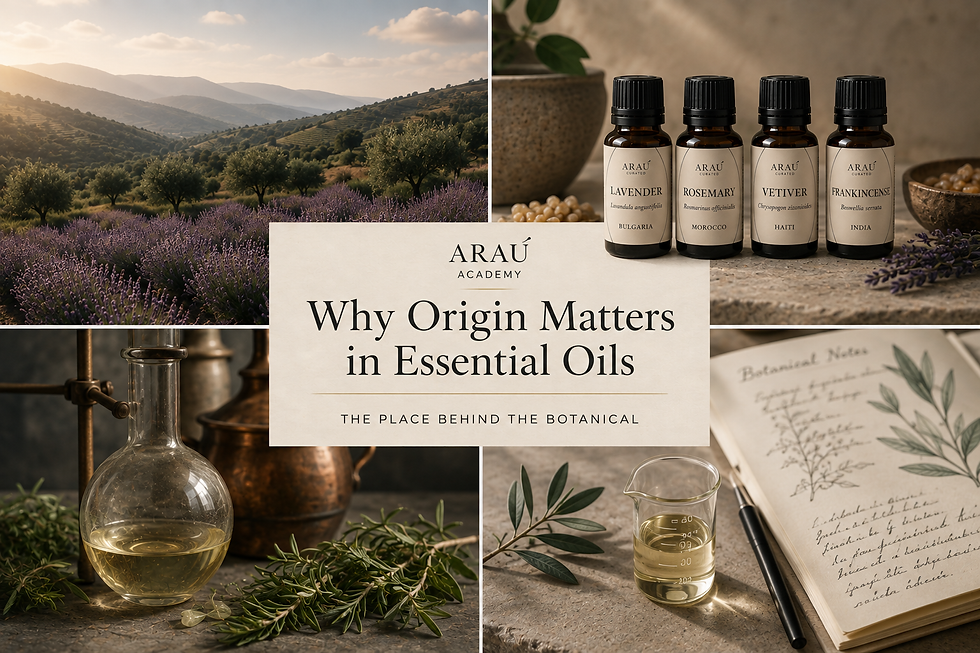
What arrives in the bottle is therefore connected not only to which plant was used, but also to where it grew, which part was harvested, when it was harvested and how its aromatic material was obtained.
Understanding that distinction is the beginning of understanding essential oils.
The “Essential” Does Not Mean Essential to the Body
The word essential can be misleading.
In everyday language, essential means necessary or indispensable. In essential oil, however, the term refers historically to the characteristic essence or aromatic character of the botanical material.
Essential oils are composed largely of volatile organic compounds — molecules that readily enter the air and reach our sense of smell. They commonly include families of compounds such as monoterpenes, sesquiterpenes and their oxygenated derivatives, among others.
This volatility explains something familiar: open a bottle and its aroma reaches you almost immediately.
But an essential oil is not one aromatic molecule. It can contain dozens, sometimes many more, compounds occurring together in different proportions.
That chemical composition contributes to the oil's characteristic aroma and physical properties.
From Botanical Material to Essential Oil
For many essential oils, the defining transformation happens through distillation.
Plant material — perhaps flowers, leaves, wood, roots or another botanical part — is exposed to steam or water and heat. Volatile compounds travel with the vapour before being cooled in a condenser. The resulting liquid separates into an aromatic water phase and the essential oil.
Not every botanical is processed in exactly the same way.
Citrus provides an important example. Oils such as sweet orange, lemon and bergamot can be obtained by mechanical expression of the outer peel rather than conventional steam distillation. International definitions and standards recognise mechanical processing of citrus peel as a method of obtaining essential oils.
This is why how an oil was obtained matters alongside the botanical name.
Not Every Botanical Oil Is an Essential Oil
This distinction becomes particularly important when we compare essential oils with carrier oils.
Jojoba, rosehip and sweet almond oil, for example, belong to a very different material category. They are often described as fixed oils — lipid-rich materials that do not evaporate readily in the way essential oils do.
Put a small amount of an essential oil on a scent strip and much of its volatile material will gradually disperse into the air. A fixed botanical oil behaves differently and leaves an oily residue.
This is also why an infused oil — botanical material steeped or extracted into a carrier oil — should not automatically be called an essential oil.
Both can be valuable botanical materials. They are simply different things.
Understanding the difference matters in formulation, labelling, storage and use.
One Plant Does Not Always Mean One Identical Oil
Once we understand what an essential oil is, another question appears:
If two bottles carry the same botanical name, are they effectively the same?
Not necessarily.
Essential-oil composition can vary with genetics, growing environment, geographic origin, plant part, maturity, season, harvest conditions and processing. Research literature documents substantial qualitative and quantitative variation associated with these factors.
Consider lavender as a simple example. Knowing that an oil is “lavender essential oil” is useful, but it is only the beginning of its identity.
We may also want to know its botanical species, plant part, geographic origin, extraction method and chemical profile.
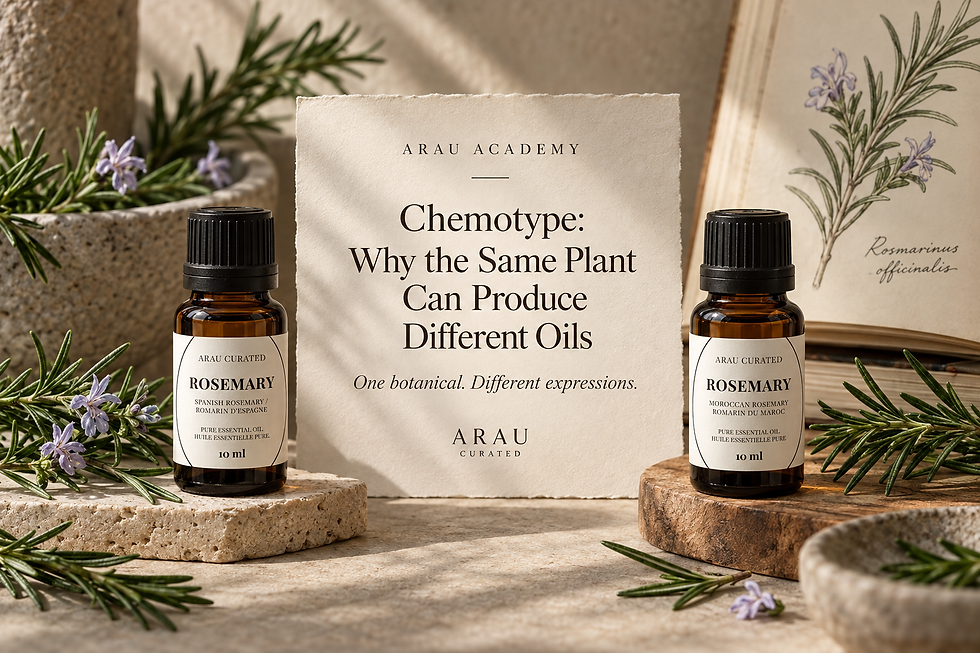
In some botanicals, chemotype becomes particularly important: plants classified within the same species can produce oils with meaningfully different dominant chemical profiles.
This is one reason botanical names and documentation matter.
Aroma Is Part of the Information
Chemistry can tell us a great deal about an essential oil, but an oil is not experienced as a laboratory table.
Its sensory character matters too.
An oil may present as bright or subdued, dry or sweet, green, resinous, woody, earthy, floral or citrus-like. Even oils belonging to the same botanical species may show sensory differences associated with provenance and composition.
Neither chemistry nor aroma should automatically replace the other.
Analytical information helps us understand what is present. Sensory evaluation helps us understand how that particular material expresses itself.
Together with provenance and documentation, they create a more complete picture.
This Is Where Curation Begins
At ARAU, understanding essential oil begins before asking whether an aroma is pleasant.
We look first at the botanical itself: its identity, plant part, origin, method of production, documentation and chemical profile where available. We then consider its sensory character and the role it could have within the collection.
That distinction is central to what we mean by curated.
We do not choose a supplier and then decide what to buy. We consider the botanical first, then seek the origin and expression that best fits the ARAU collection.
This also means that origin alone is not a guarantee of superiority.
A celebrated growing region can be meaningful. So can a particular species, harvest or traditional production method. But none should remove the need to evaluate the material itself.
Origin should inform selection, not replace evaluation.
A Small Bottle, a Larger Story
An essential oil may occupy only 10 or 30 millilitres of space, but behind it sits a much larger chain of decisions.
There is the plant.
There is its geography and growing environment.
There is the part of the plant selected for production.
There is harvest and extraction.
There is chemistry.
There is aroma.
And finally, there is the question of why that particular expression was selected.
Learning about essential oils therefore becomes much more interesting once we move beyond asking simply, “What does it smell like?”
The better questions are:
What botanical is this? Where did it come from? How was it produced? What does its composition tell us — and what makes this particular expression worth choosing?
Those are the questions that will guide the next chapters of ARAU Academy.